통합 검색

통합 검색

Papers for 2020~2021


We pursue valuable research and continuously publish papers. Through these publications, both large and small

we solve problems and contribute to the preservation of people, the environment, and the planet. 
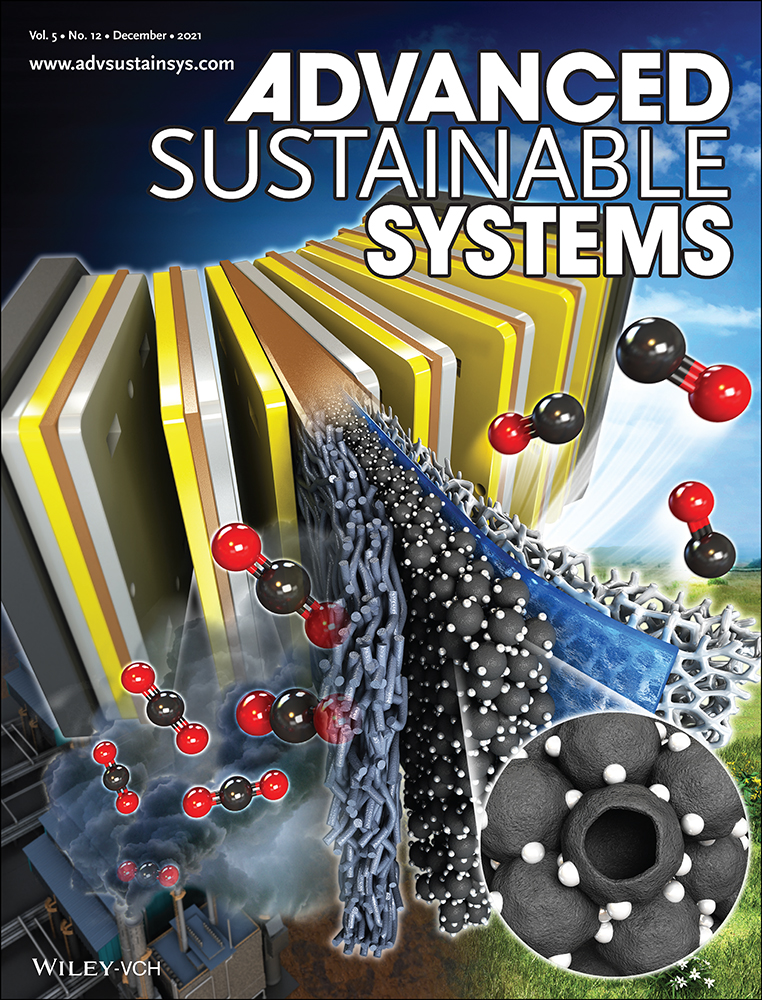
  Advanced Sustainable Systems

   December 2021  vol 5 : 2100216  


“Enhancement of Catalytic Activity and Selectivity for the

  Gaseous Electroreduction of CO₂ to CO: Guidelines for the

  Selection of Carbon Supports”


   Chulwan Lim, Woong Hee Lee, Jong Ho Won, Young‐Jin Ko, Sangkuk Kim, Byoung Koun Min,

   KwanYoung Lee, Won Suk Jung, Hyung‐Suk Oh.

   Abstract

   To secure the economic feasibility of electrochemical carbon dioxide reduction reaction (CO₂RR), a method of

    using support materials to reduce the amount of catalyst loading and increase catalytic activity for CO₂RR can be

    a solution. Herein, guidelines for selecting carbon support materials suitable for CO₂RR are reported.

    In a gaseous CO₂-fed CO₂RR electrolyzer, an Ag nanoparticle-composited carbon nanocage (denoted as Ag/CNC)

    electrode exhibits an optimal performance for CO₂RR with a partial current density of ≈400 mA cm−2. Ag/CNC

    showcases a uniformly dispersed morphology with Ag nanoparticles and sufficient hydrophobicity after... ...


  Applied Catalysis B: Environmental,

  September 2021  vol 293 : 120205 


“Persulfate activation by nanodiamond-derived carbon onions:

  Effect of phase transformation of the inner diamond core on

  reaction kinetics and mechanisms”


   Bowen Yang, Haisu Kang, Young-Jin Ko, Heesoo Woo, Geondu Gim, Jaemin Choi, Jaesung Kim,

   Kangwoo Cho, Eun-Ju Kim, Seung-Geol Lee, Hongshin Lee, Jaesang Lee.
  Abstract
   To investigate the impact of carbon phase conversion on the catalytic activity of nanodiamonds, in this study,
    we tested nanodiamonds subjected to graphitization at varying temperatures for persulfate activation.
    Temperatures beyond 1000°C (where only surface graphitization occurs) steadily enhanced the persulfate
    activation capability as the inner carbon underwent substantial sp3-to-sp2 transformation. Nanodiamonds
    annealed at 2000°C outperformed benchmark nanocarbons in terms of persulfate activation efficiency.
    Non-radical activation occurred primarily based on the effects of radical quenchers, oxidation product... ...

  Nature Communications

   13 July 2021  vol 12 : 1-10


“High crystallinity design of Ir-based catalysts drives catalytic

  reversibility for water electrolysis and fuel cells”


   Woong Hee Lee, Young-Jin Ko, Jung Hwan Kim, Chang Hyuck Choi, Keun Hwa Chae,

   Hansung Kim, YunJeong Hwang, Byoung Koun Min, Peter Strasser, Hyung-Suk Oh .

   Abstract
   The voltage reversal of water electrolyzers and fuel cells induces a large positive potential on the hydrogen
   electrodes, followed by severe system degradation. Applying a reversible multifunctional electrocatalyst to the
   hydrogen electrode is a practical solution. Ir exhibits excellent catalytic activity for hydrogen evolution reactions
   (HER), and hydrogen oxidation reactions (HOR), yet irreversibly converts to amorphous IrOx at
   potentials > 0.8 V/RHE, which is an excellent catalyst for oxygen evolution reactions (OER), yet a poor HER and
   HOR catalyst. Harnessing the multifunctional catalytic characteristics of Ir, here we design a unique Ir-based
   electrocatalyst with high crystallinity for OER, HER, and HOR. Under OER operation, the crystalline nanoparticle
   generates an atomically-thin IrOx layer, which reversibly transforms into a metallic Ir at more cathodic... ...

  Journal of Materials Chemistry A

  15 July 2021  vol 9 :  16169-16177 


“New strategies for economically feasible CO₂ electroreduction

  using a porous membrane in zero-gap configuration”


   Woong Hee Lee, Kyeongsu Kim, Chulwan Lim, Young-Jin Ko, Yun Jeong Hwang, Byoung Koun Min,

   Ung Lee, Hyung-Suk Oh.

    Abstract
    The high capital cost of electrolyzers is one of the major obstacles encountered in the industrial adoption of
    electrochemical CO₂ reduction (CO₂R) systems. The anion exchange membrane (AEM) is a major contributor to
    the cost of electrolyzers. Herein, we propose a strategy for improving the economic feasibility by applying a
    low-cost porous membrane (PM). For a CO2R reaction (CO₂RR), the activity and selectivity of an electrolyzer using
    a PM were found to be similar to those achieved using an AEM. Furthermore, the physical properties of PM,
    such as pore size, hydrophobicity, and thickness, can be tuned to suit the CO₂RR. A techno-economic analysis of
    the entire process revealed that adopting a PM is economically advantageous compared to adopting... ...

  Environmental Science & Technology

   12 November 2020  vol 54 : 15424-15432 


“Activation of hydrogen peroxide by a titanium oxide-supported

  iron catalyst: evidence for surface Fe (IV) and its selectivity”


   Hak-Hyeon Kim, Hongshin Lee, Donghyun Lee, Young-Jin Ko, Heesoo Woo, Jaesang Lee,

   Changha Lee, Anh Le-Tuan Pham.

   Abstract
   Iron immobilized on supports such as silica, alumina, titanium oxide, and zeolite can activate hydrogen peroxide
   (H₂O₂) into strong oxidants. However, the role of the support and the nature of the oxidants produced in this
   process remain elusive. This study investigated the activation of H₂O₂ by a TiO₂-supported catalyst (FeTi-ox).
   Characterizing the catalyst surface in situ using X-ray absorption spectroscopy (XAS), together with X-ray
   photoelectron spectroscopy (XPS) and electron paramagnetic resonance (EPR), revealed that the interaction
   between H₂O₂ and the TiO₂ phase played a key role in the H₂O₂ activation. This interaction generated a stable
   peroxo–titania ≡Fe(III)–Ti–OOH complex which reacted further with H₂O to produce a surface oxidant... ...

  Nano Energy

  October 2020  vol 76 :  105030


“Highly selective and scalable CO2 to CO-Electrolysis using

  coral-nanostructured Ag catalysts in zero-gap configuration”


   Woong Hee Lee, Young-Jin Ko, Yongjun Choi, Si Young Lee, Chang Hyuck Choi, Yun Jeong Hwang,

   Byoung Koun Min, Peter Strasser, Hyung-Suk Oh.
   Abstract
   The direct electroreduction of CO2 to pure CO streams has attracted much attention for both academic research
   and industrial polymer synthesis development. Here, we explore catalytically very active, coral-structured Ag
   catalyst for the generation of pure CO from CO2-feeds in lab-bench scale zero-gap CO2 electrolyzer. Coral-shaped
   Ag electrodes achieved CO partial current densities of up to 312 mA cm−2, EECO of 38%, and FECO clearly above
   90%. In-situ/operando X-ray Absorption Spectroscopy revealed the sustained presence of Ag+ subsurface species,
   whose local electronic field effects constitute likely molecular origins of the favorable experimental kinetics and
   selectivity. In addition, we show how electrode flooding in zero-gap CO2 electrolyzer compromises efficient
   CO2 mass transfer. Our studies highlight the need for a concomitant consideration of factors related to intrinsic
   catalytic activity of the active phase, its porous structure and its hydrophilicity/phobicity to achieve... ...

  Chemical Communications

   27 August 2020  vol 86 : 12687-12697 (co-first author) 


“Single-atom catalysts for the oxygen evolution reaction: recent    developments and future perspectives”


   Woong Hee Lee, Young-Jin Ko, Jun-Yong Kim, Byoung Koun Min, Yun Jeong Hwang, Hyung-Suk Oh.

   Abstract
   Single-atom catalysts (SACs) possess the potential to achieve unique catalytic properties and remarkable catalytic
   mass activity by utilizing low-coordination and unsaturated active sites. However, smaller particles tend to
   aggregate into clusters or particles owing to their high surface energy. In addition, support materials that have
   strong interactions with isolated metal atoms, extremely large surface areas, and electrochemical stability are
   required. Therefore, sufficient information about these factors is needed to synthesize and utilize SACs. Herein,
   we review the recent investigations and advances in SACs for the oxygen evolution reaction (OER). We present
   not only the structural characterization of SACs, but also in situ/operando spectroscopic techniques and
   computational research for SACs to understand the mechanism and reveal the origin of their excellent OER... ...

  Environmental Science

  17 April 2020  vol 6 : 1627-1637


“Investigation of titanium mesh as a cathode for

  the electro-Fenton process: consideration of the practical

  application in wastewater treatment”


   Jiho Lee, Aseom Son, Young-Jin Ko, Min-Jung Shin, Woong Sub Kim, Jae-Woo Choi, Jaesang Lee,

   and Seok Won Hong.

   Abstract
   This study investigated the performance of organic pollutant degradation using the electro-Fenton process and
   low-cost titanium (Ti) electrodes as cathodes. Three Ti electrodes with different morphologies, i.e., a plate and
   two meshes with large (MS-L) and small (MS-S) opening sizes, were evaluated using electrochemical
   characterization, as well as kinetic and energy studies based on the COD removal performance of the
   electro-Fenton process. The preliminary results indicated that the MS-S electrode, which has the largest
   electrochemically active surface area and lowest resistance amongst the three electrodes, could reduce Fe3+ to
   Fe2+ most effectively in the synthetic solution. However, when treating real wastewater, MS-L rather than... ...

  Journal of Materials Chemistry A

   30 April 2020  vol 8 : 9859-9870 


“A catalyst design for selective electrochemical reactions:

  Direct production of hydrogen peroxide in advanced

  electrochemical oxidation”


   Young-Jin Ko, Keunsu Choi, Boram Yang, Woong Hee Lee, Jun-Yong Kim, Jae-Woo Choi,

   Keun Hwa Chae, Jun Hee Lee, Yun Jeong Hwang, Byoung Koun Min, Hyung-Suk Oh,

   and Wook-Seong Lee.

   Abstract
   Hydrogen peroxide production by enhanced electrocatalysts is an attractive alternative to the present commercial
   process. While the subnano/atomic dispersion in noble metal nanocatalysts is known to strongly enhance their
   catalytic efficiency and chemoselectivity, their excessive surface energy and consequent coarsening seriously
   compromise their physical/chemical stability. Here, we report a subnano/atomically dispersed Pt–Ag alloy
   (by a simply modified polyol process) that is resistant to agglomeration/Ostwald ripening. This catalyst... ...

Contact Us

    Would you like to be partner with us?

    If you or your institution would like to collaborate on a paper or participate in a project, please feel free to contact our office.