.png)
통합 검색
통합 검색
Papers for 2018~2019
We pursue valuable research and continuously publish papers. Through these publications, both large and small
we solve problems and contribute to the preservation of people, the environment, and the planet.
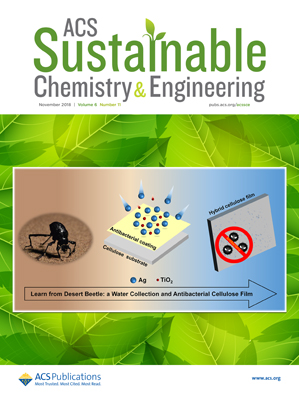
ACS Sustainable Chemistry & Engineering
April 2018 vol 6 : 14857-14865
“Ionic-liquid-derived nitrogen-doped carbon as electro-Fenton
catalyst for removal of dye and pharmaceutical compounds”
Young-Jin Ko, Hee-Gon Kim, Mingizem Gashaw Seid, Kangwoo Cho, Jae-Woo Choi, Seok Won Hong,
Wook-Seong Lee.
Abstract
We investigated the activities of the ionic-liquid-derived (by pyrolysis) nitrogen-doped carbon as the
electrocatalyst for the two-electron oxygen reduction reaction (ORR) and regeneration of divalent iron in the
electro-Fenton process, focusing on the pyrolysis-temperature-dependent evolution of the doping structure.
The results provided insight into the evolution of the catalytic activity as a function of the pyrolysis temperature.
On the basis of the XPS N 1s analysis, the pyrolysis temperature was optimized at the 900 °C since the pyridinic/
graphitic N structures which are known to be active sites for the ORR were maximized (4.29% pyridinic N and
7.30% graphitic N). The carbonyl surface group, which is known to be an active site for the Fe3+/Fe2+ redox, was
also maximized at the pyrolysis temperature of 900 °C (1.11%). This catalyst, adopting two simultaneously... ...
Water Research
15 November 2018 vol 145 : 287-296
“Strong chromate-adsorbent based on pyrrolic nitrogen
structure: Anexperimental and theoretical study on the
adsorption mechanism”
Young-Jin Ko, Keunsu Choi, Soonjae Lee, Kyung-Won Jung, Hiroshi Mizuseki, Jae-Woo Choi,
WookSeong Lee.
International Journal of Hydrogen Energy
11 October 2018 vol 43 : 19029 - 19037
“Palladium Nanoparticles from Surfactant/Fast-Reduction
Combination One-pot Synthesis for the Liquid fuel cell
Applications”
Young-Jin Ko, Jun-Yong Kim, Kyeong-Seok Lee, Jong-Keuk Park, Young-Joon Baik, Heon-Jin Choi,
Wook-Seong Lee.
Carbon
Feburary 2018 vol 127 : 31-40
“Onion-like Carbon as Dopant/Modification-Free Electrocatalyst
for [VO]₂+/[VO₂]+ Redox Reaction:
Performance-Control Mechanism”
Young-Jin Ko, Keunsu Choi, Jun-Yong Kim, Inho Kim, Doo Seok Jeong, Heon-Jin Choi,
Hiroshi Mizuseki, Wook-Seong Lee.
Would you like to be partner with us?
If you or your institution would like to collaborate on a paper or participate in a project, please feel free to contact our office.
.png)


