통합 검색

통합 검색

Papers prior to 2018


We pursue valuable research and continuously publish papers. Through these publications, both large and small

we solve problems and contribute to the preservation of people, the environment, and the planet. 
  Applied Catalysis B: Environmental

    April 2017  vol 203 : N684-691 


“Tungsten carbide nanowalls as electrocatalyst for hydrogen

  evolution reaction: New approach to durability issue”


   Young-Jin Ko, Jung-Min Cho, Inho Kim, Doo Seok Jeong, Kyeong-Seok Lee, Jong-Keuk Park,

   YoungJoon Baik, Heon-Jin Choi, Wook-Seong Lee.

   Abstract

   We report a new approach to the durability issue in tungsten carbide electrocatalyst for hydrogen evolution

   reaction (HER), in a form radically differing from that of the conventional nanoparticle approach: the WC

   nanowalls, bottom-up grown by a plasma-assisted deposition on Si wafer. The pristine nanowall was highly

   crystalline and its surface was smooth in atomic scale, which enabled a superior durability in HER environment:

   no oxidation occurred at prolonged cycling (10,000 cycles) in the HER environment, even without additional

   functionalization or modification. The electrochemical activity, as presented by Tafel slope and turnover frequency

   (TOF), was as excellent as those of the best data in the literature... ...


  Journal of Hazardous Materials

  15 December 2016  vol 320 : 368-375 


“Chromate adsorption mechanism on nanodiamond-derived

  onion-like carbon”


   Young-Jin Ko, Keunsu Choi, Soonjae Lee, Jung-Min Cho, Heon-Jin Choi, Seok Won Hong,

  Jae-Woo Choi, Hiroshi Mizuseki, Wook-Seong Lee.

  Abstract
  The onion-like carbon (OLC) was prepared as adsorbent and tested for the removal of chromate ions from
  aqueous solutions. The OLC was thermally derived from nanodiamond by vacuum annealing at 1000⿿2000 °C.
  An investigation was conducted the chromate adsorption mechanism of OLC, by analysing
  the temperature-dependent evolution of the various oxygen-carbon bonds and the chemisorbed water by X-ray
  photo electron spectroscopy, as well as by the first principle calculation of the bond energies for relevant bond
  configurations. The present work demonstrated the importance of the carbon-oxygen bond type and carbon
  dangling bonds for chromate adsorption, as well as for other anionic heavy metals adsorbed from wastewater
  and sewage.

  Scientific Reports

   01 April 2016  vol 6 : 23913 


“Inherently-Forced Tensile Strain in Nanodiamond-Derived

  Onion-like Carbon: Consequences in Defect-Induced

  Electrochemical Activation”


   Young-Jin Ko, Jung-Min Cho, Inho Kim, Doo Seok Jeong, Kyeong-Seok Lee, Jong-Keuk Park,

   YoungJoon Baik, Heon-Jin Choi, Seung-Cheol Lee, Wook-Seong Lee.

  Abstract
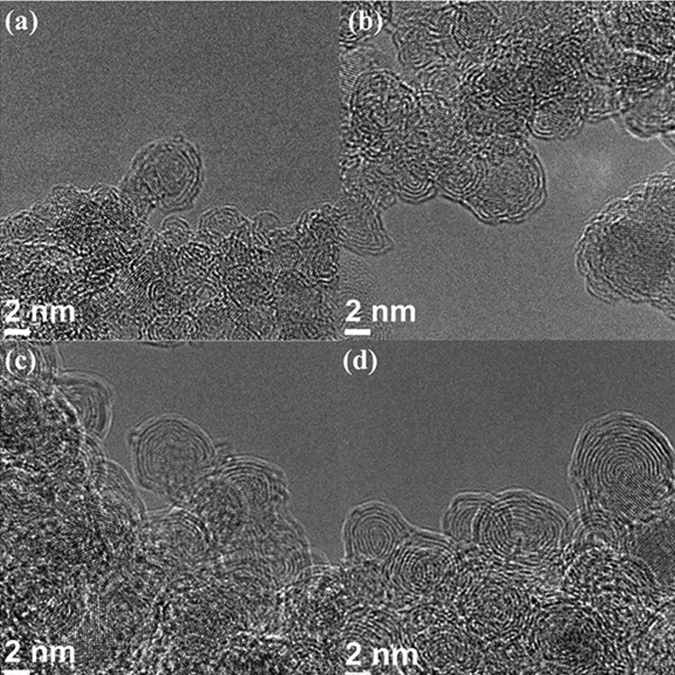
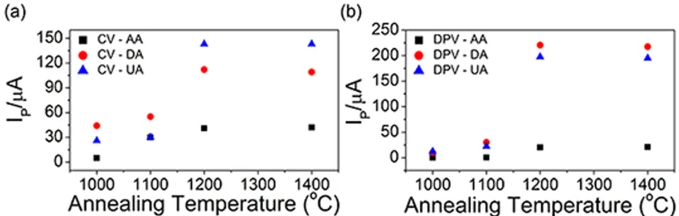
   We analyzed the nanodiamond-derived onion-like carbon (OLC) as function of synthesis temperature
   (1000~1400 °C), by high-resolution electron microscopy, electron energy loss spectroscopy, visible-Raman
   spectroscopy, ultraviolet photoemission spectroscopy, impedance spectroscopy, cyclic voltammetry and
   differential pulse voltammetry. The temperature dependences of the obtained properties
  (averaged particle size, tensile strain, defect density, density of states, electron transfer kinetics, and
  electrochemical oxidation current) unanimously coincided: they initially increased and saturated at 1200 °C... ...

  International Journal of Hydrogen Energy

  January 2010  vol 35 :  701-708 


“Effect of chemical oxidation of CNFs on the electrochemical

  carbon corrosion in polymer electrolyte membrane fuel cells”


    Hyung-Suk Oh, Kwanghyun Kim, Young-Jin Ko, Hansung Kim.
    Abstract
    Effect of chemical oxidation of carbon nanofibers (CNFs) on the electrochemical carbon corrosion in polymer
    electrolyte membrane (PEM) fuel cells is examined. With increasing time of chemical oxidation treatment using
    an acidic solution, more oxygen functional groups are formed on the surface of CNF resulting in an increasingly
    hydrophilic carbon surface. This effect contributes to improvements in Pt loading and the distribution of Pt
    particles on carbon supports. However, the chemical oxidation treatment is found to accelerate electrochemical
    carbon corrosion. The oxygen functional group and the hydrophilic nature of CNFs after chemical oxidation
    treatment are believed to encourage the formation of CO₂, which is a product of carbon corrosion. From the
    observed results, it can be concluded that the chemical oxidation of CNFs is beneficial for catalyst loading and
    distribution. On the other hand, however, it reduces the durability of the PEM fuel cells caused by the
    electrochemical carbon corrosion.

  Journal of Power Sources

   01 May 2010  vol 195 : 2623-2627  


“Effect of heat-treatment temperature on carbon corrosion

  in polymer electrolyte membrane fuel cells”


   Young-Jin Ko, Hyung-Suk Oh, Hansung Kim.

   Abstract
   This study examines the effect of heat-treatment temperature on the electrochemical corrosion of carbon
    nanofibers (CNFs) in polymer electrolyte membrane (PEM) fuel cells. Corrosion is investigated by monitoring the
    generation of CO₂ using an on-line mass spectrometer at a constant potential of 1.4 V for 30 min.
    The experimental results show that the generation of CO₂ decreases with increasing heat-treatment temperature,
    indicating that less electrochemical carbon corrosion occurs. In particular, when the heat-treatment temperature
    is 2400 °C, the change intensifies. X-ray photoelectron spectroscopic analysis shows that oxygen functional groups
    on the carbon surface decrease with increasing heat-treatment temperature. A reduction in oxygen functional
    groups increases the hydrophobic nature of the carbon surface, which is responsible for the increased corrosion
    resistance of CNFs.

  Journal of Power Sources

  05 September 2009  vol 193 :  575-579

“Effect of operating conditions on carbon corrosion in polymer

  electrolyte membrane fuel cells”


    Katie Heeyum Lim, Hyung-Suk Oh, Sang-Eun Jang, Young-Jin Ko, Hyun-Jong Kim, Hansung Kim.
   Abstract
   The influence of humidity, cell temperature and gas-phase O2 on the electrochemical corrosion of carbon in
    polymer electrolyte membrane fuel cells is investigated by measuring CO2 emission at a constant potential of
    1.4 V for 30 min using on-line mass spectrometry. Carbon corrosion shows a strong positive correlation with
    humidity and cell temperature. The presence of water is indispensable for electrochemical carbon corrosion.
    By contrast, the presence of gas-phase O2 has little effect on electrochemical carbon corrosion. With increased
    carbon corrosion, changes in fuel cell electrochemical characteristics become more prominent and thereby
    indicate that such corrosion significantly affects fuel cell durability.

Contact Us

    Would you like to be partner with us?

    If you or your institution would like to collaborate on a paper or participate in a project, please feel free to contact our office.